

Overwintering Legumes
Cover Crop Strategies
Legumes are flowering cover crops that produce nitrogen through a process called nitrogen fixation. They make nitrogen out of thin air, but it’s not magic. It’s biology, and it makes them very helpful in a vegetable garden. There’s lots of ways to garden. This is a no-till approach to using fall planted, overwintering legumes to prepare the garden for next year’s nitrogen-loving crops. The Marion County SWCD Demonstration Garden uses this strategy to prepare garden beds for sweet corn, brassicas, tomatoes, peppers, and more.
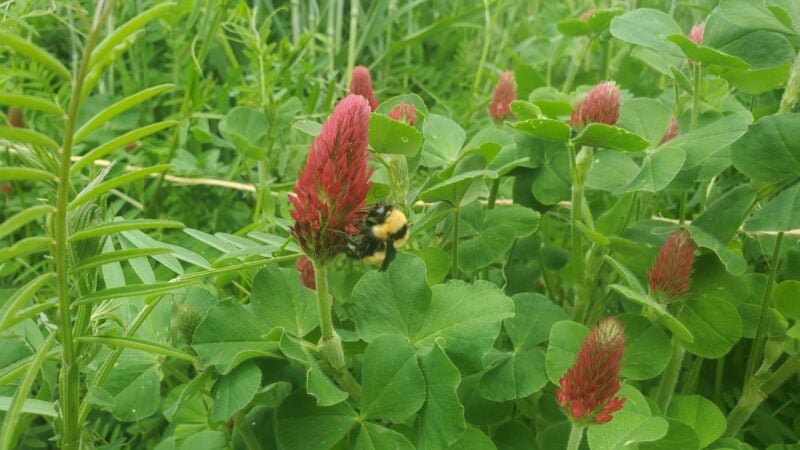
Hairy vetch and crimson clover legume cover crop mix with crimson clover in spring bloom.
Overwintering Legume Cover Crop Species
Go-to overwintering legume cover crops in Indiana are hairy vetch, crimson clover, or a combination of the two.
Add a winterkilled cover crop such as oats to increase diversity and weed suppression. When the mix is planted in fall, the oats often winterkill or terminate in an Indiana winter, and the legumes survive to grow into spring and produce more nitrogen as they progress towards flower.
Legumes also pair well with cereal rye, a vigorous overwintering grass, but for the purposes of this strategy, leave the bulky cereal rye out to allow for quicker termination of tender nitrogen-rich legumes. This keeps the carbon to nitrogen ratio low to leverage more nitrogen production for the next crop.
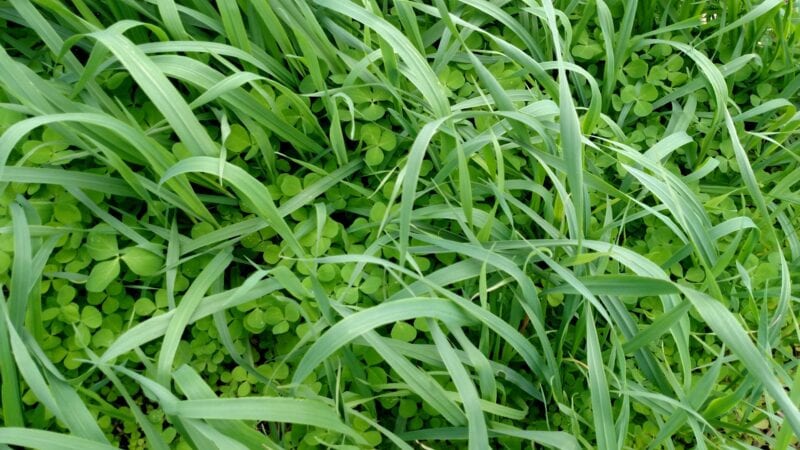
Crimson clover legume and oats mix
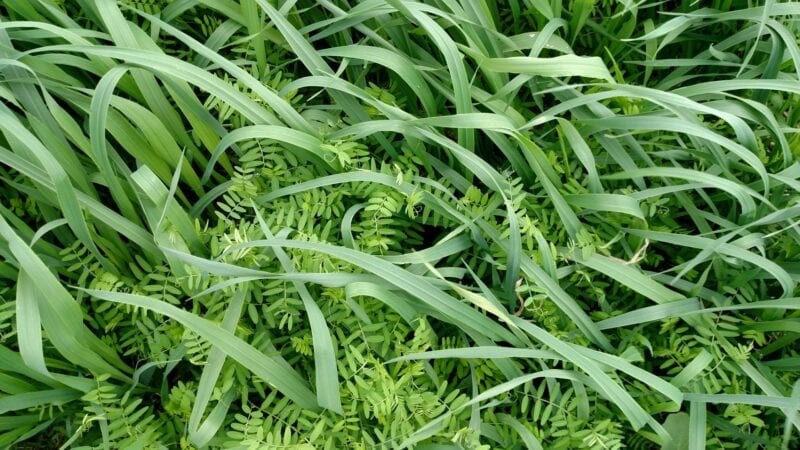
Hairy vetch legume and oats mix
Seeding Rates
For seeding rates, the SWCD suggests using a high rate of legumes and a low rate of oats. The Indiana Cover Crop Seeding Table, Indiana Cover Crop Tool, and the Seeding Methods resources are located at marionswcd.org/soilhealth under cover crops. These resources can help determine the amount of seed needed in ounces per square feet and tips on how to plant it.
In general, keep oats or radishes to low rates so as to not outcompete and smother the legumes. Increase the seeding rate of oats to normal or high if planting later in the seeding window. More oats may germinate, but they won’t have time to grow as thick as those planted earlier. If the oats do get too thick in fall, it may be possible to cut or trim the tops of the oat vegetation to let the legumes have more light and space.
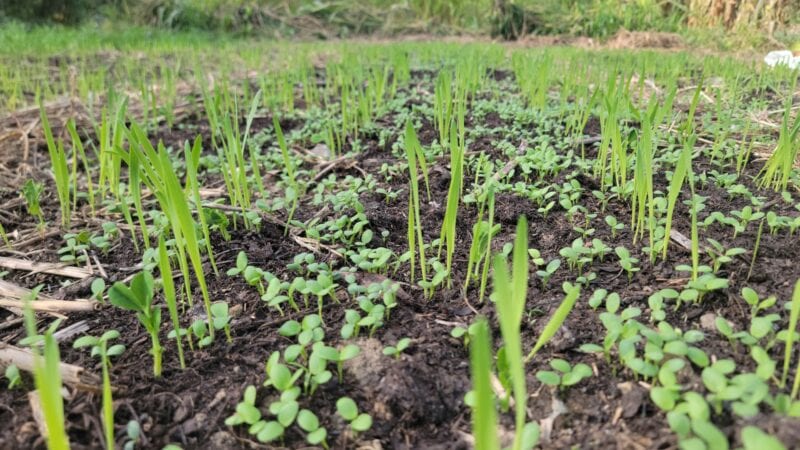
Crimson clover and oats, seeded in fall
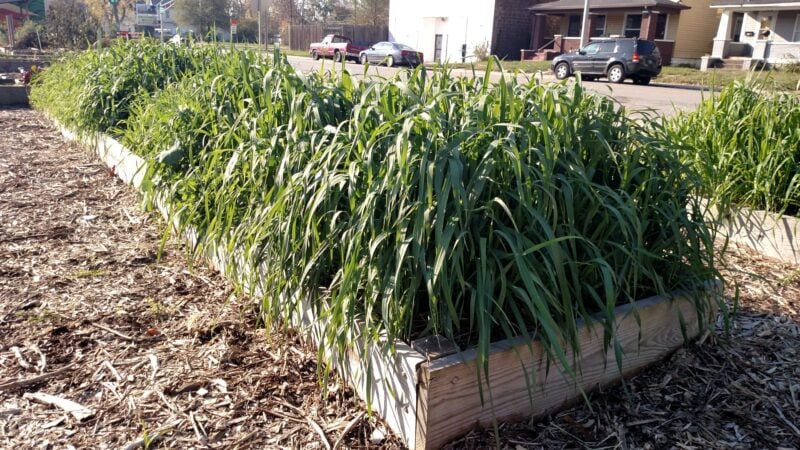
If oats are planted too thickly, they can outcompete legumes. If this happens, the cover crop mix may winterkill.
Seed Inoculation for Nitrogen-Fixing Bacteria
For legumes, the seed should be inoculated with the proper bacteria to encourage nitrogen production. Either buy pre-inoculated seed or apply inoculant directly to the seed before planting. Ensure the inoculant product is compatible with the specific legume species you are planting. The nitrogen-fixing bacteria live in nodules on legume roots, where the bacteria convert nitrogen gas from the air into a form of nitrogen the plant can uptake for its growth. When the legume is terminated or decomposes, the stored nitrogen is released, and the nitrogen enriches the soil and the next crop. A pink center inside the nodule indicates more active nitrogen production.
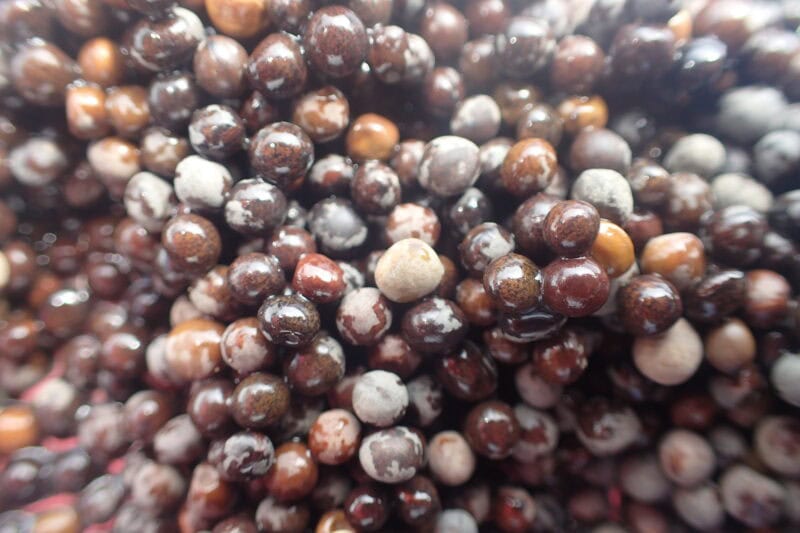
Inoculated hairy vetch seed
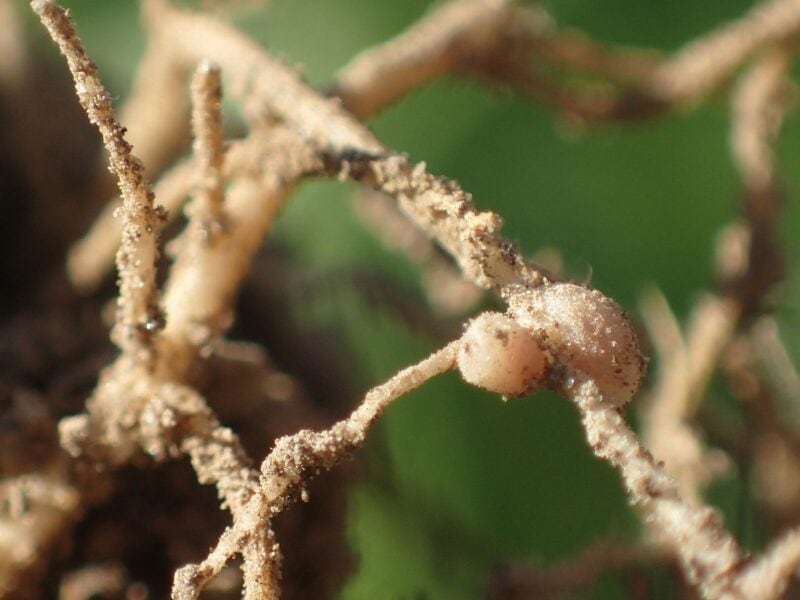
Nitrogen-fixing bacteria nodules on legume roots. Nodules that are actively producing nitrogen tend to have a pink center.
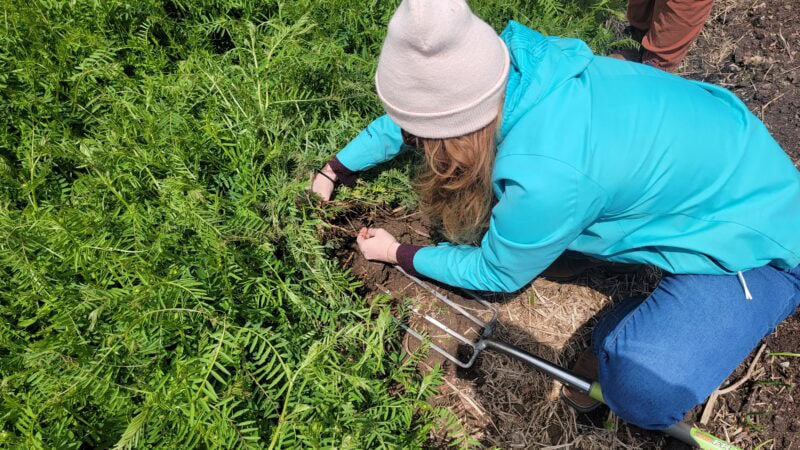
Soil conservationist examining nodules on the roots of legumes in spring
Seeding Windows
For cover crop planting timing, the Indiana Cover Crop Seeding Windows, which shows common cover crop species and their best planting windows. In central Indiana.
At the Marion County SWCD Demonstration Garden, crimson clover is often planted from mid-August to late September and flowers in mid-April to mid-May of the following year. Hairy vetch is often planted mid-August to early October and flowers mid-May to early June. Flower timing is variable and may be dependent upon location, variety weather, soil conditions, etc.
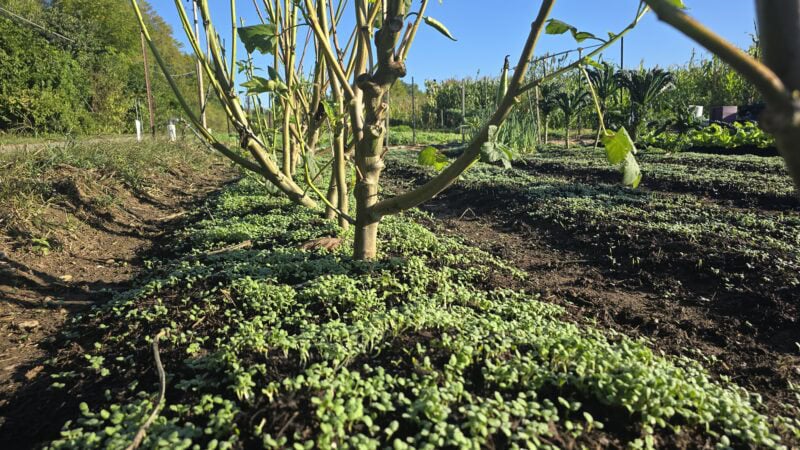
Crimson clover planted after Okra
Cover Crop Growth
Expect some fall growth, a pause in winter, and then spring growth as a legume pushes towards flower. On occasion, a legume that is expected to overwinter can winterkill. Winter-hardy varieties can be helpful. If legumes do die, try to keep the soil covered in other ways such as adding mulch. If the oats survive, expect to need a longer period for no-till termination such as an additional week of tarping in the spring as oats and grasses tend to take longer to terminate than legumes.
As the legume grows further into spring, there’s more roots, more time for building soil health, and more nitrogen production as legumes progress towards flower. Continuously scout for weeds and remove them before they set seed.
Legumes also attract beneficial insects in spring, when many of the native plants around the garden aren’t yet blooming.
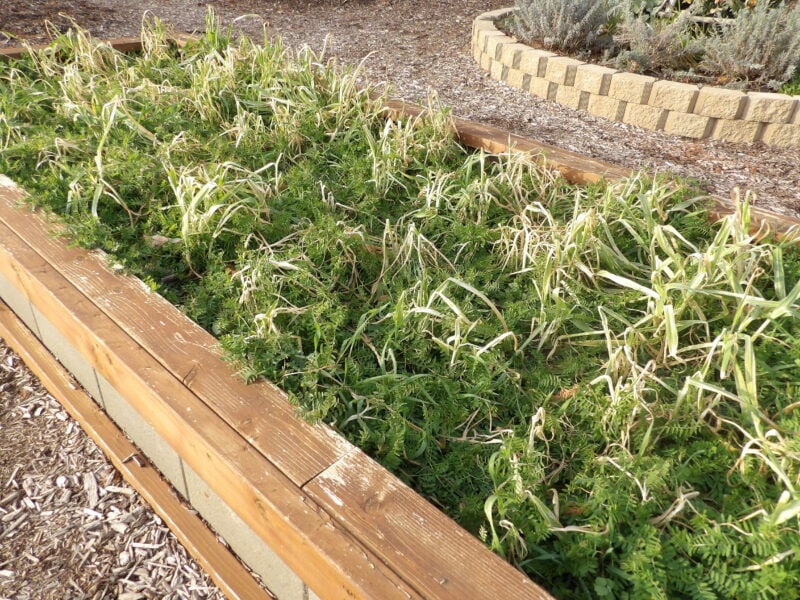
Winterkilled oats and early spring hairy vetch growth
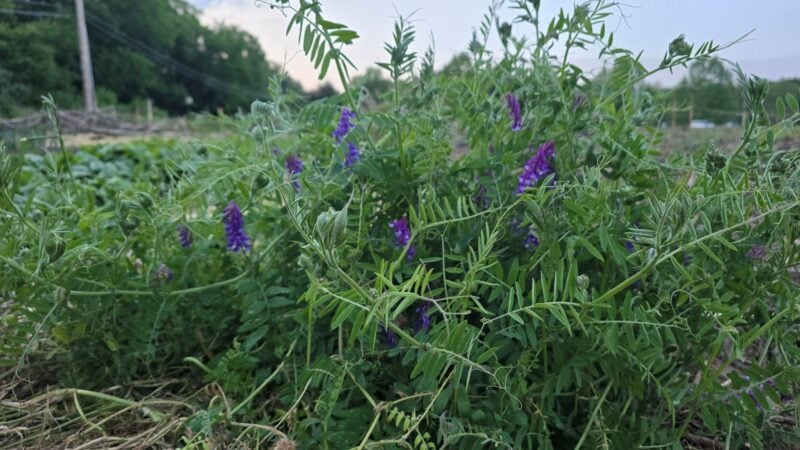
Hairy vetch flowering in the spring
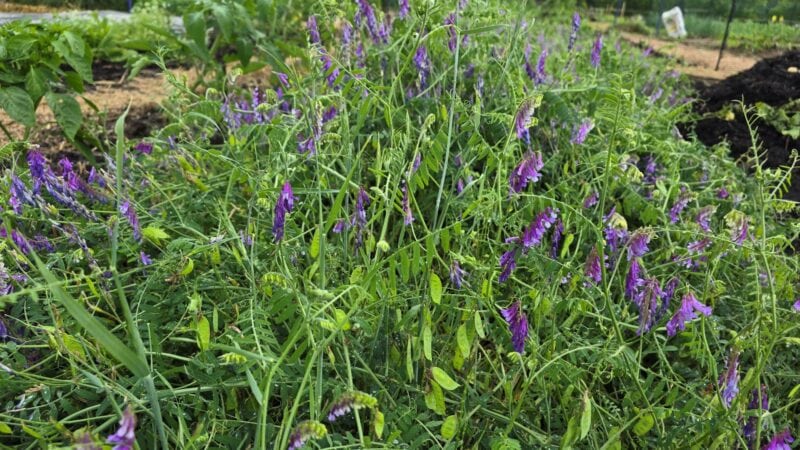
After a period of flowering, the hairy vetch produces seed pods. Terminate the cover crop before seed pods produce viable seed.
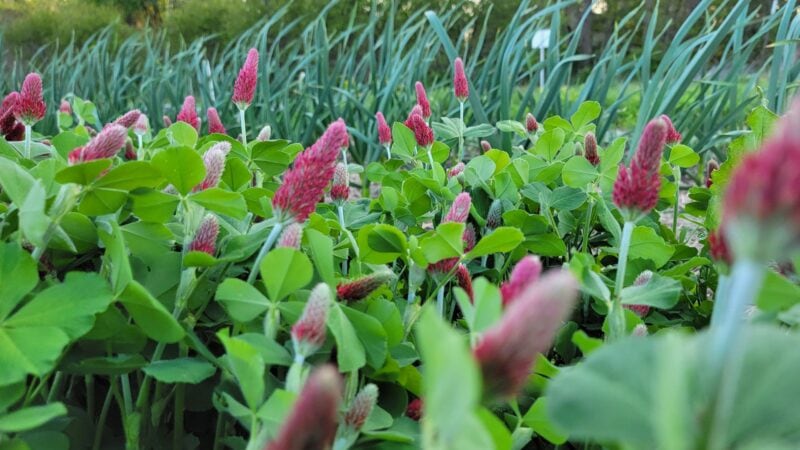
Crimson clover flowering
Introduction to Legume Termination
In the spring, the goal is to terminate the cover crop and plant vegetables. In the context of no-till, the SWCD Demonstration Garden plan is as follows:
- Cut, mow, or weed whack the legume.
- Use one or more additional termination methods to ensure complete termination, especially if cut pre-flower.
- Cut multiple times
- Mulch up thickly
- Tarp for 2-3 weeks or until fully terminated
Termination Timing Considerations
- Begin with enough time to fully terminate before planting a crop.
- Legumes are most susceptible to termination during the flower stage. The plant directs energy to reproduction instead of growth.
- Cutting pre-flower may result in vegetative regrowth. Use additional termination methods.
- If left to bloom for too long, the legume may reseed itself.
- A legume approaches peak nitrogen at flower. Expect less nitrogen contribution if cut earlier than flower.
SWCD Demo Garden legume termination regularly begins with a weed whacker. Crimson clover has an upright growth habit, while hairy vetch vines. Ensure the stems are severed just above the soil surface for best success. Flail mowers or strong weed whackers are helpful tools, but hand tools can also work.
The nitrogen-rich plant vegetation is often left on the soil surface and the roots undisturbed. Then plant vegetables if the cover crop is terminated or begin additional measures such as tarping or mulching to ensure complete termination.
To plant vegetables, make spaces or rows in the residue; then transplant or direct seed. The legume residue is easier to manipulate If allowed to become brittle or more thoroughly cut.
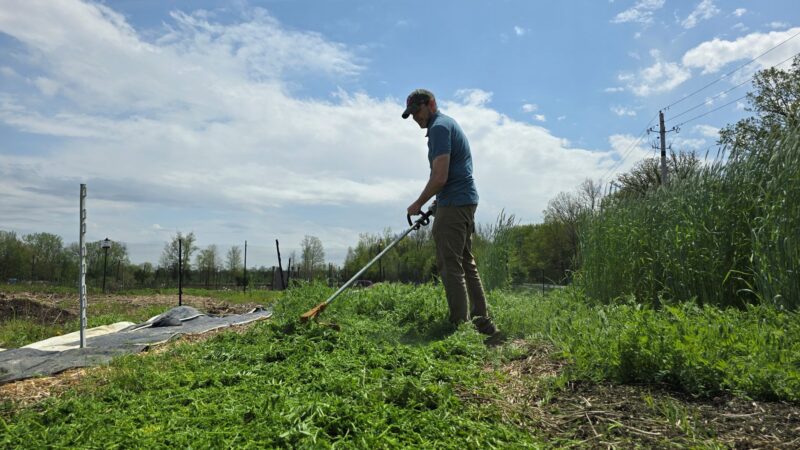
Weed whacking hairy vetch
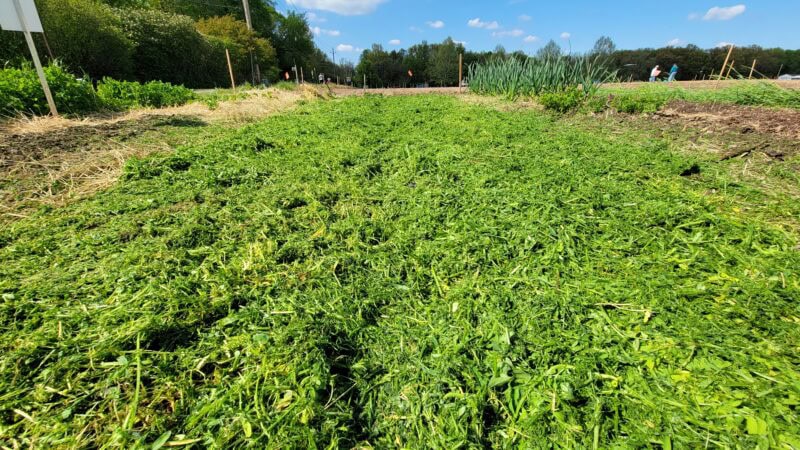
Weed whacked hairy vetch vegetation
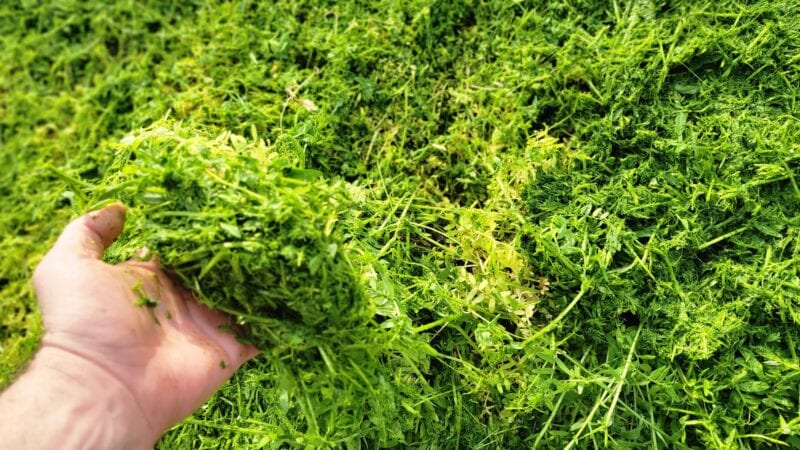
Chopped up hairy vetch vegetation
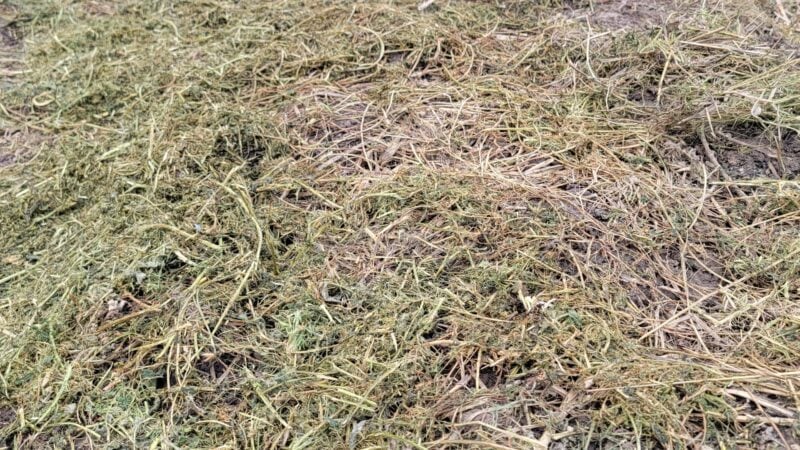
Hairy vetch vegetation turning brown and more brittle as the plants die
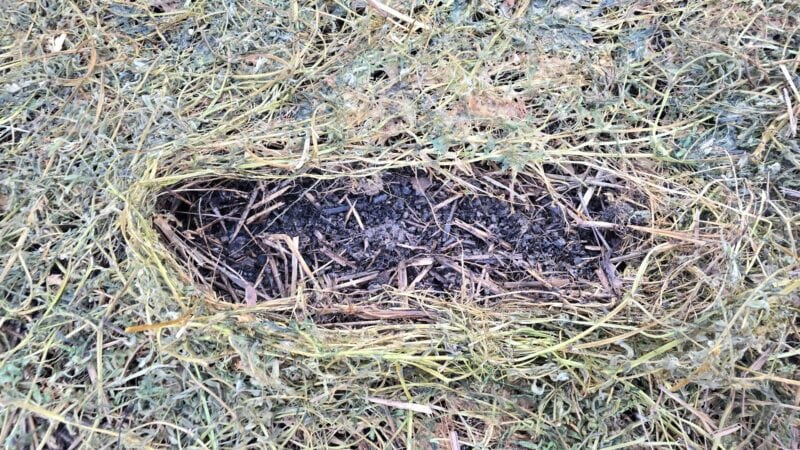
Spaces or planting rows can be made in the legume cover crop residue to facilitate crop planting
Termination by Multiple Cuttings
One method to ensure termination is to repeatedly cut the legume until its energy is exhausted. Cut, let it regrow, and cut again. It is a bit unpredictable in how many cuttings it might take, or if certain weeds will survive it, but it can be effective. Multiple cuttings break the residue down further. For those gardeners pushing row seeders to plant, most models won’t easily cut through dead legume vegetation unless it is chopped up very well, further decomposed, or raked aside.
Legume mulch has a low C:N and decomposes more quickly than grasses. Coarsely chopped vegetation results in longer lasting soil cover and relatively slower nitrogen release. Finely chopped vegetation leads to faster decomposition and nitrogen release.
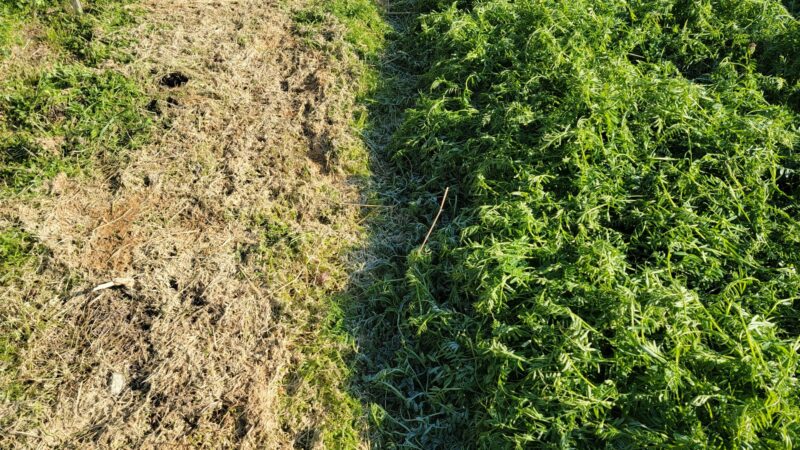
Hairy vetch regrowth after first cutting (left)
Termination by Mulching Up
Mulching up heavily is another method to supplement cutting and increase termination success. Mulching up also provides longer lasting 100% soil cover for soil health,
The mulch further smothers weeds and suppresses potential legume regrowth, especially when cut before the flowering stage. If cutting the legume early, a light mulch might not stop the legume’s regrowth, so thicker mulch can be beneficial. Though not always necessary, a layer of newspaper on top of the cut legume and under the straw or compost mulch can help block light and reduce regrowth.
Mulches placed on top of the cut legume might include compost, leaf mulch, or straw, as long as the mulch is compatible with the crop.
After mulching, waiting approximately 10 days before transplanting allows the mulch to block light before opening transplanting spaces. SWCD demonstrations have successfully planted crops the same day as termination and mulching, though there is an increased chance for cover regrowth around the transplants.
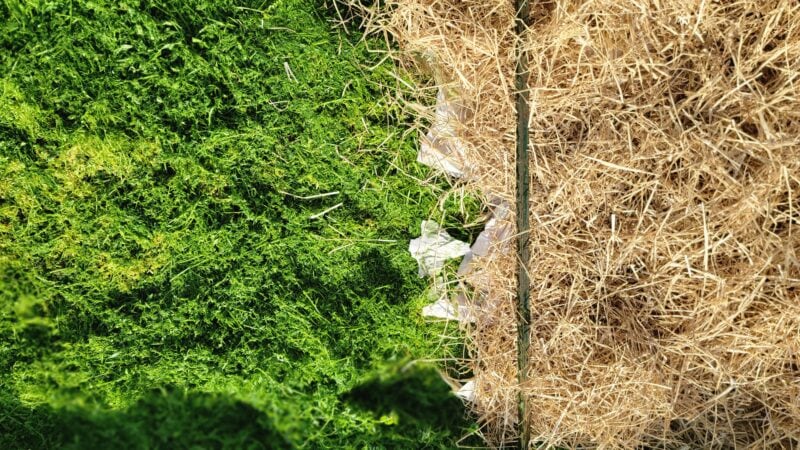
Hairy vetch > Cut > Mulched up with newspaper and straw
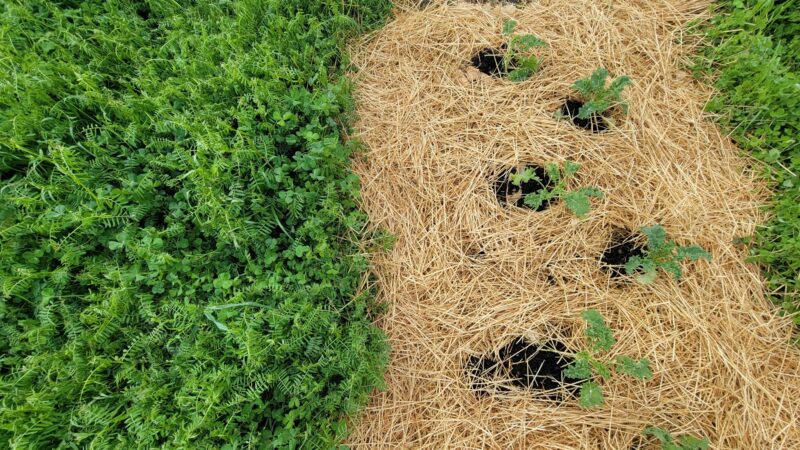
Kale planted in terminated hairy vetch, mulched up with straw
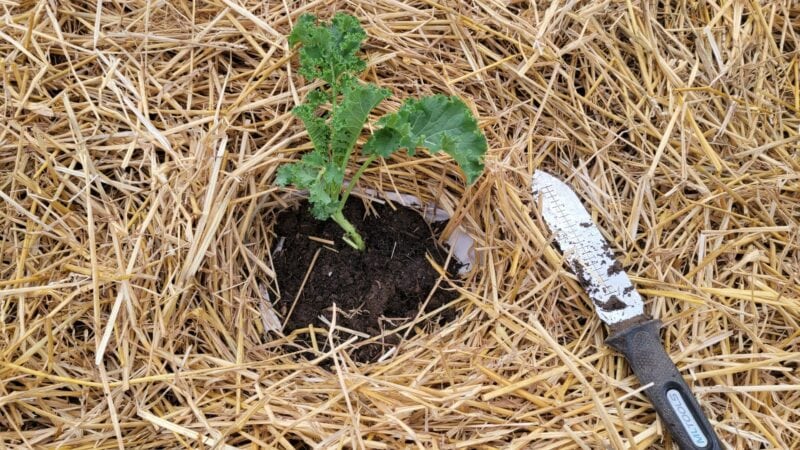
Kale transplanted into legume cover crop mulch and straw
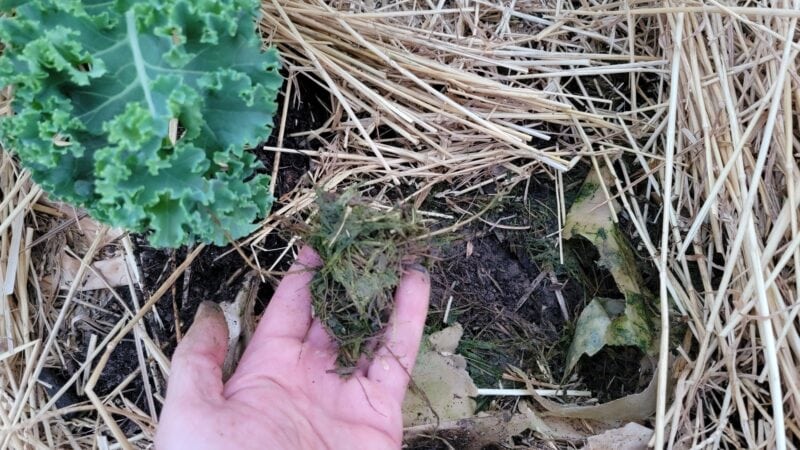
The ‘mulching up’ strategy caps the decomposing nitrogen-rich legume vegetation with a soil covering mulch.
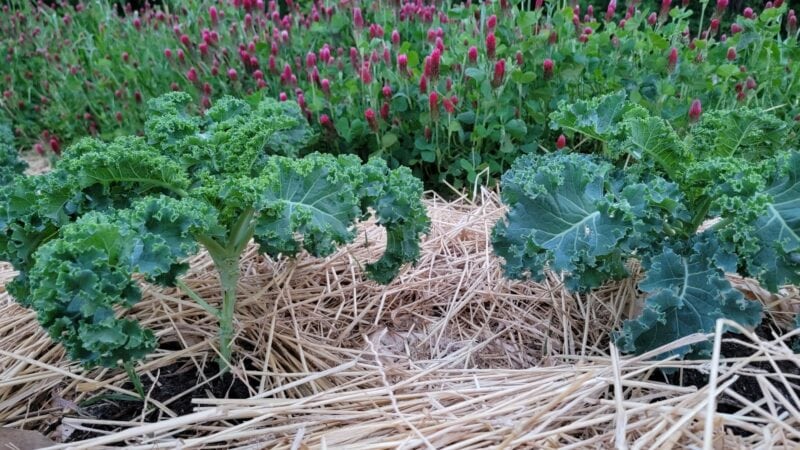
Crimson clover > Cut > Mulched up with straw > Transplanted kale
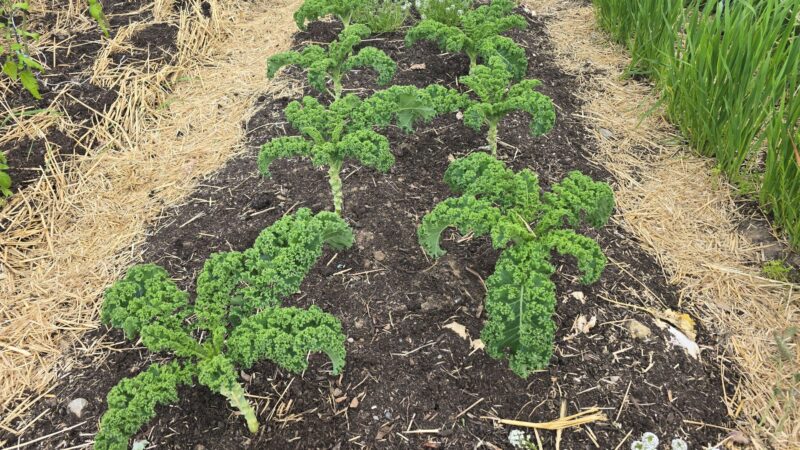
Crimson clover > Cut > Mulched up with newspaper and compost > Transplanted kale
Termination by Tarping
One of the most effective ways to ensure legume cover crop termination in the garden is to cut or mow and then tarp for approximately two to three weeks. The tarp duration can vary so keep tarping until fully terminated. Tarping duration may be decreased if the legume is cut during the flowering stage. However, some weeds may need extended time.
The tarp is then removed, and the dead legume mulch can be managed to best complement how the next crop is planted, whether it be making spaces or rows for transplants or seed or mulching up.
The tarp usually sets back weeds very well. However, the legume mulch decomposes fairly quickly and mulching up ensures soil 100% cover for soil health and continued weed suppression.
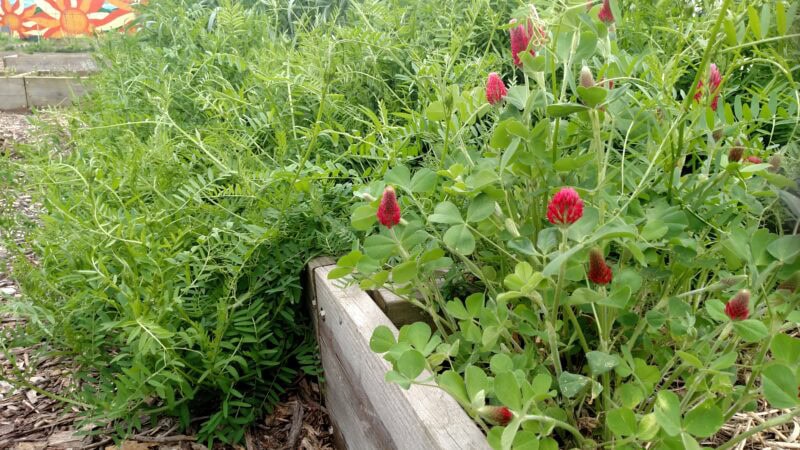
Tarping can be helpful in a multi-species mix. In this scenario, the crimson clover is blooming and the hairy vetch is still in its vegetative state. Cutting may terminate the crimson clover but not hairy vetch. Cutting and tarping ensures termination for both species.
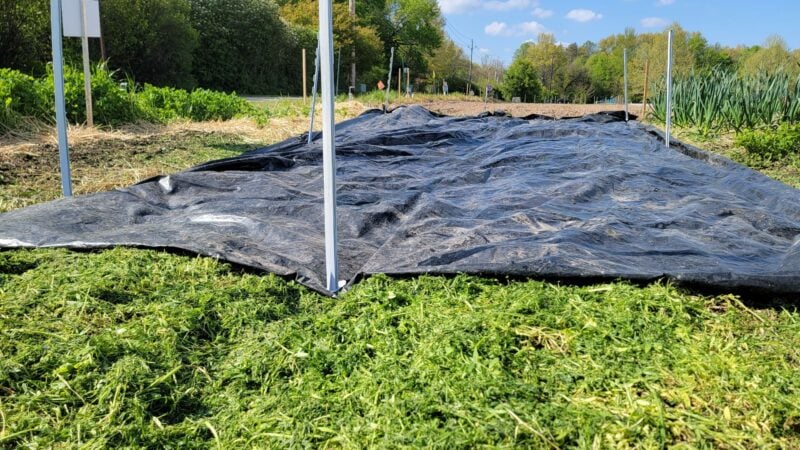
Tarped hairy vetch in spring. The portion of this bed that was not tarped produced more weeds than the tarped portion.
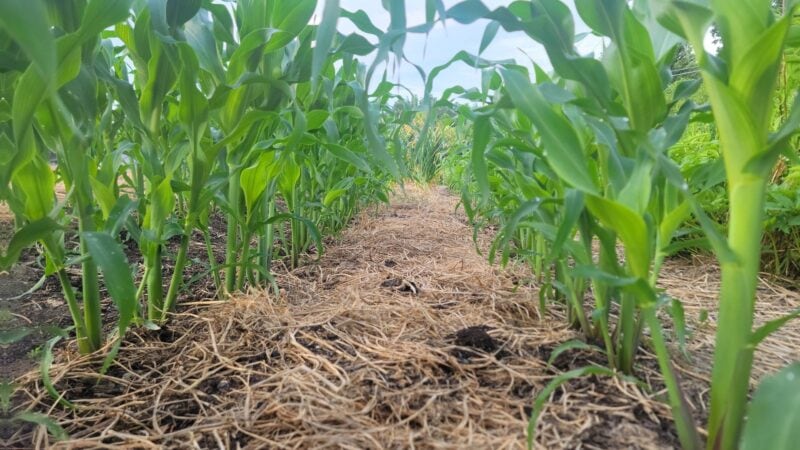
Hairy vetch > Tarp > Sweet Corn
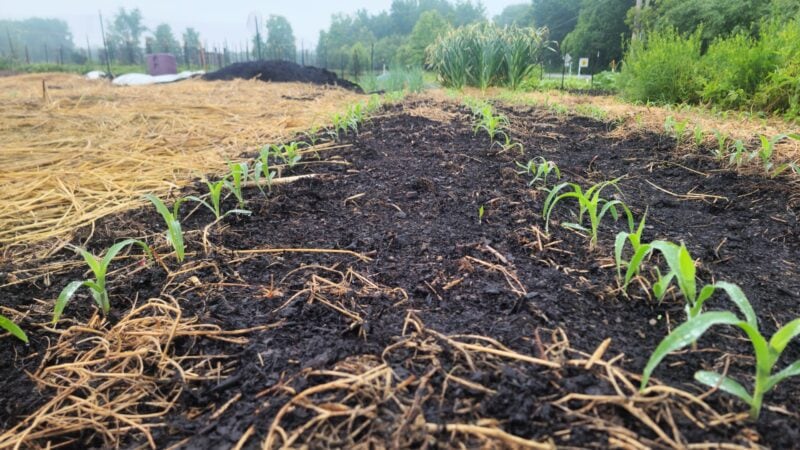
Mulching up in combination with tarping helps ensure complete termination and longer lasting soil cover
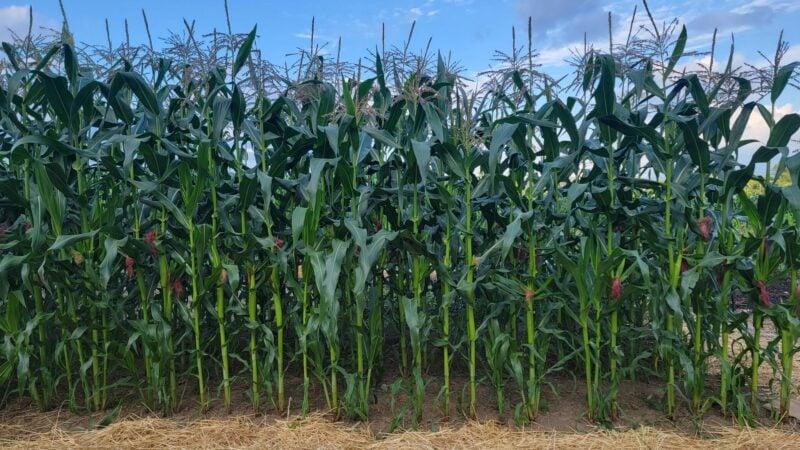
Legumes > Weed whacked > Tarped > Untarped > Sweet Corn
Cover Crop to Crop Transition
Learning to balance termination methods and timing with crop planting methods and timing for specific crops is helpful for executing a good cover crop to crop sequence. Allowing legumes to grow further into spring increases the amount of beneficial cover crop roots in the soil and increase nitrogen production. Balance that knowledge while still ensuring to begin termination early enough time to completely terminate the cover crop before planting vegetables.
Marion County SWCD Demonstration Garden Favorite Cover Crop to Crop Sequences
Fall-planted Overwintering Legumes; In spring:
1. Mow or cut and mulch up > Wait 10 days > Transplant brassicas
2. Mow or cut 2 or 3 times or tarp if weedy > Mulch up with light compost > Direct-seed April and May crops
3. Mow or cut and tarp if weedy > Mulch up > Plant May tomatoes and peppers
4. Mow or cut and tarp > Mulch up with light compost > Plant sweet corn
Find out more about crop rotations in the Crop Rotation section of marionswcd.org/soilhealth/
Legume Nitrogen Contribution
Legumes can provide nitrogen to the follow crop. The following publications contain information that can help estimate the amount of plant available nitrogen to expect from a cover crop or cover crop mix. Results can vary greatly and per a host of variables including the type of cover crop. growth stage at termination, temperature, and more. In general, the further the legume grows into spring, the more nitrogen it provides. While vegetative samples can also be analyzed for better estimations, use the graphs and trends available at the following resources provide working baselines for estimating the available nitrogen.
Example: If the university recommendation for sweet corn is 2.75 pounds of nitrogen per 1,000 square feet, a nitrogen credit of 1.8 pounds from the legume accounts for almost half of the crop’s nitrogen demand and the amount of fertilizer inputs can be decreased.
For more information on nitrogen contribution from cover crops, check out these resources.
- Oregon State University: Estimating plant-available nitrogen release from cover crops. Figure 4: Effect of kill date on typical plant available N (PAN) release from cereal, legume, or mixed stands. Based on a compilation of field data from Willamette Valley cover crop trials. Credit: Dan Sullivan, © Oregon State University
https://extension.oregonstate.edu/catalog/pnw-636-estimating-plant-available-nitrogen-release-cover-crops - University of Nebraska-Lincoln, How Much Nitrogen Does My Cover Crop Take Up and When Do I Get it Back?
Figure 1: Estimated cumulative nitrogen release of cereal rye and hairy vetch residue over 16 weeks of decomposition with corn growth stages. (Sievers and Cook, 2018) https://cropwatch.unl.edu/2020/how-much-nitrogen-does-my-cover-crop-take-and-when-do-i-get-it-back/ - Oregon State University. OSU organic fertilizer & cover crop calculator: Predicting plant-available nitrogen
https://extension.oregonstate.edu/catalog/pub/em-9235-osu-organic-fertilizer-cover-crop-calculator-predicting-plant-available/ - ResearchGate: Decomposition and nitrogen release of cover crops of reduced- and no-tillage systems
https://www.researchgate.net/figure/Estimated-cumulative-nitrogen-release-of-cereal-rye-and-hairy-vetch-residue-over-10-wk-of_fig3_340919776
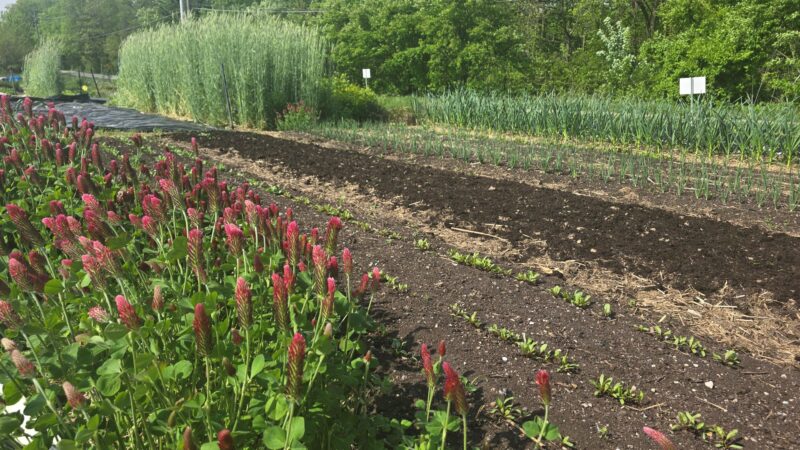

Content and photography by Kevin Allison, Marion County SWCD
Produced in partnership with Indiana’s Natural Resources Conservation Service, North Central SARE, and Clean Water Indiana.
Indiana – Updated December 2025
This work is supported by the Marion County SWCD, the USDA Natural Resources Conservation Service, Clean Water Indiana, and North Central SARE. This material is based upon work that is supported by the the National Institute of Food and Agriculture, U.S. Department of Agriculture, under agreement number 2024-38640-42989 through the North Central Region SARE program under project number ENC24-233. USDA is an equal opportunity employer and service provider. Any opinions, findings, conclusions, or recommendations expressed in this publication are those of the author(s) and do not necessarily reflect the view of the U.S. Department of Agriculture.